1. Background
Single-task agents today are already remarkably capable: give one a clear prompt inside an isolated session, and it will read code, invoke tools, and drive the task all the way home. Yet the moment we try to rely on an agent around the clock as an everyday Personal Agent, the interaction pattern changes completely. Real daily work rarely runs as a neat, single-threaded queue where you finish Task A before starting Task B. More often, you are mid-conversation aligning on edge cases for Requirement A, pause to slip in an unrelated quick lookup B, and meanwhile Feishu/Slack messages, document updates, and GitHub issues keep arriving asynchronously in the background.
Once concurrent tasks pile up, the bottleneck is no longer the model’s single-turn reasoning power—it is human attention bandwidth. If every incoming item forces you to manually spin up and babysit a new session, alt-tab across a dozen terminals and git worktree checkouts, and copy-paste findings from Window A into Window B, context-switching quickly drains your focus. As the DeepSeek Harness team recently noted in Exploring Super-agent Design: a session is fundamentally an engineering implementation detail that should never be pushed onto the user; the core goal of a Personal Agent is to trade as little human attention as possible for maximal delivered value.
To handle concurrent workloads behind a single continuous user entry point, mainstream industry designs largely follow two paths:
Router + Workermaster-worker dispatch (exemplified bySuper-agent): a lightweight top-levelRouterstripped of heavy execution tools stays resident to greet the user and listen to external events; whenever real work is needed, it drafts a constrained natural-language ticket (Ticket / Mandate) and dispatches an isolatedWorkerunderneath;- Multi-role
Agent Teams: defining specialized teammates—Team Lead, PM, developer, QA—that coordinate complex tasks through role division, message passing, and hierarchical reporting.
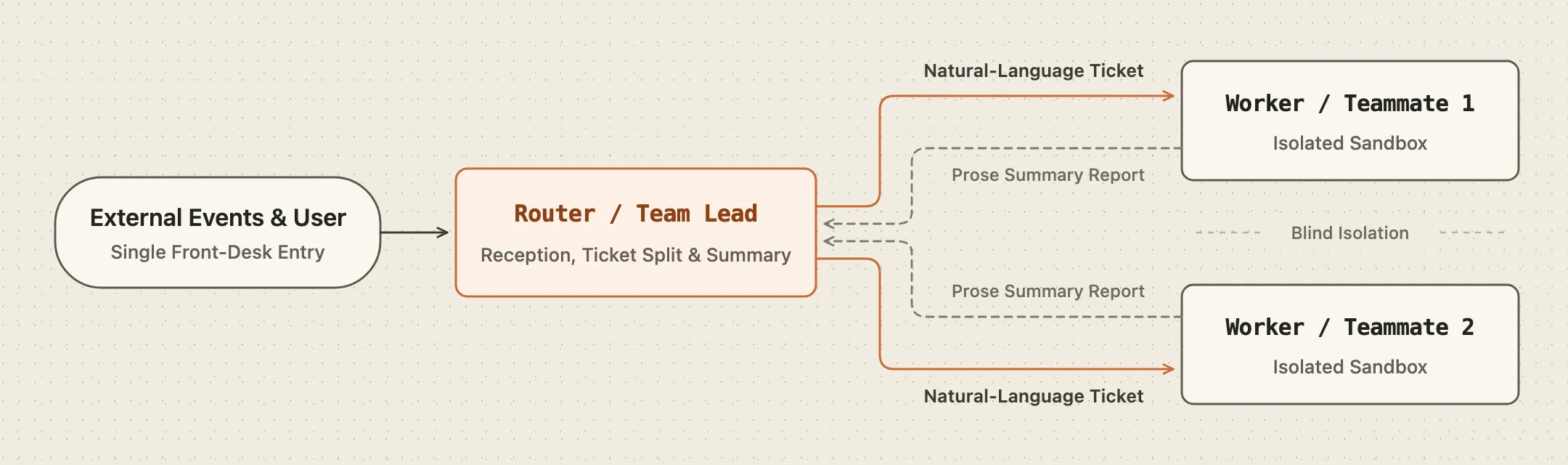
Look closely at both designs and you will see they borrow the exact same blueprint: human corporate and team org charts—a manager in the middle receiving requests and writing tickets, isolated contributors executing underneath, and prose summaries flowing back up.
Humans evolved corporate hierarchies because of two inescapable biological constraints. On both counts, the physical nature of agents is completely different from humans:
-
Humans have heterogeneous capabilities; agents in one system share the exact same model weights In a human team, a product manager, backend engineer, and legal counsel hold distinct knowledge bases and must collaborate through role specialization and management layers. In most agent systems, however, both the top-level
Router / Team Leadand the underlyingWorker / Teammaterun on the exact same LLM weights—effectively the same brain. Copying human delegation onto homogeneous agents creates an inversion of ground truth and authority: theWorkerthat actually holds live file and tool context cannot speak directly with the user, while theRouterthat lacks ground-truth details commands theWorker—drafting its ticket, defining its boundaries, and even answering user follow-ups on its behalf. -
Humans can only communicate via lossy language; homogeneous agents can read each other’s “brains” losslessly Humans collaborate through natural language—a biological signal that inherently compresses information, with compression quality varying wildly across speakers. Summarizing a multi-turn alignment dialogue into a natural-language ticket inside an agent stack suffers from the exact same lossy compression: every handoff drops nuance depending on how the prompt summarizes it. Agents do not have this limitation. A same-weight agent can directly read or inherit another instance’s “brain”—its exact token sequence and KV cache—with zero loss. Treating agent collaboration like human interpersonal communication is far from optimal.
When this human-style ticket dispatch meets high-frequency interleaved daily workflows, four concrete engineering pain points surface:
- Multi-topic pollution in the single front-desk session: Even when underlying
Workersare isolated, the user-facing entry remains one linear top-level session. When you discuss Requirement A, pause for an unrelated read-only lookup B, and return to green-light A, disparate topics and async tickets mix inside the same top-level context—causing constraint bleed or dropped mid-flight replies. - Blind-spot divergence and merge cliffs across isolated walls: Concurrent
WorkersorTeammates(or manually parallel sessions) run completely blind to one another. When two sessions modify the same codebase in parallel, conflicts stay hidden until final merge into the main branch—sometimes exposing irreconcilable signature or architectural clashes that could have been caught the moment both sides touched a shared module. The same happens in data and office tasks: if an external webhook triggersWorker 1to paginate records in the background and the user adds a follow-up requirement in chat, a freshly spawnedWorker 2blind toWorker 1’s criteria easily produces contradictory numbers. - Rigid dispatch overhead for trivial tasks: Even a five-second read-only lookup has to pay the full ceremony of ticket creation, context handoff, or workspace directory allocation—adding latency and burning extra tokens.
- Ephemeral worker amnesia: Once an execution worker finishes and terminates, the implicit API or environment constraints it spent a dozen tool steps uncovering vanish with it; the next task hitting the same interface has to rediscover every pitfall from scratch.
Tracing these symptoms back to their root leads to a direct question: Since every instance shares the same model brain, can we step outside human corporate hierarchies, drop the middleman Router / Team Lead, and organize context blocks as schedulable resources—much like an operating system’s virtual memory—so users enjoy a seamless single window while gaining lossless same-brain continuation from alignment to execution and verified fact-sharing across concurrent tasks?
Existing agent benchmarks already cover coding, multi-agent collaboration, dynamic environments, and real-world tool use. Here, we focus on workloads that combine these capabilities: interleaved topics within one chat window, incoming asynchronous events, and context continuity and coordination across tasks. Below, we introduce the ClonAct framework built around this idea, followed by the core findings from stress-testing it across interleaved workloads and continuous arrival streams.
2. Method
2.1 Dropping the Router: Context Blocks as Virtualized Resources
If every instance behind a Personal Agent runs on identical frozen model weights, splitting them into a “front-desk manager” and “back-office executors” solves the wrong problem. ClonAct removes the resident generative Router altogether and treats context blocks directly as schedulable OS-like resources, organized into four collaborating modules:
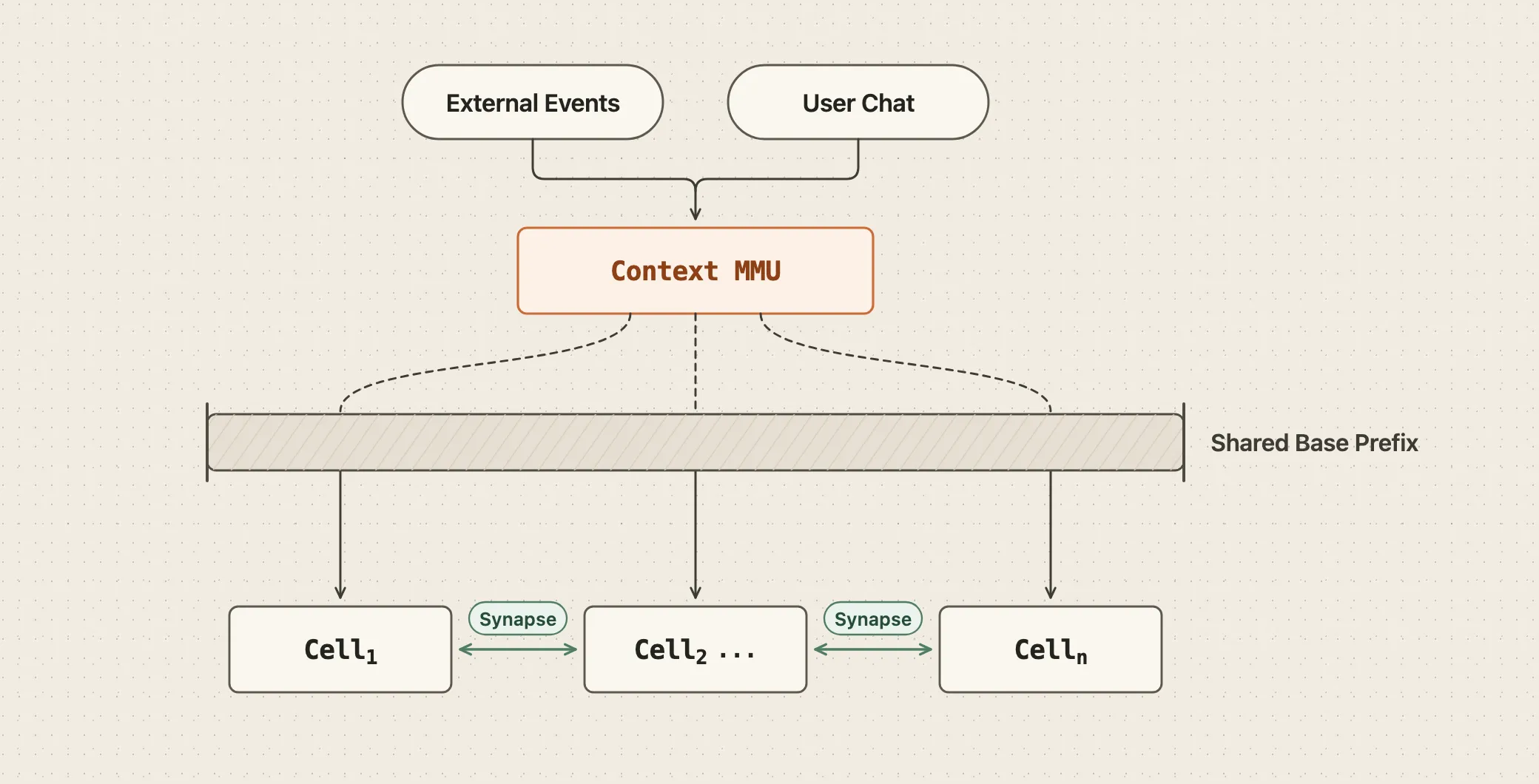
To the user, nothing changes on the surface—there is still one continuous chat window. Underneath, however, there is no resident front-desk session paraphrasing messages between you and a hidden worker. Every incoming message or webhook connects directly to the specific Context Cell that owns the live files and tool state for that task:
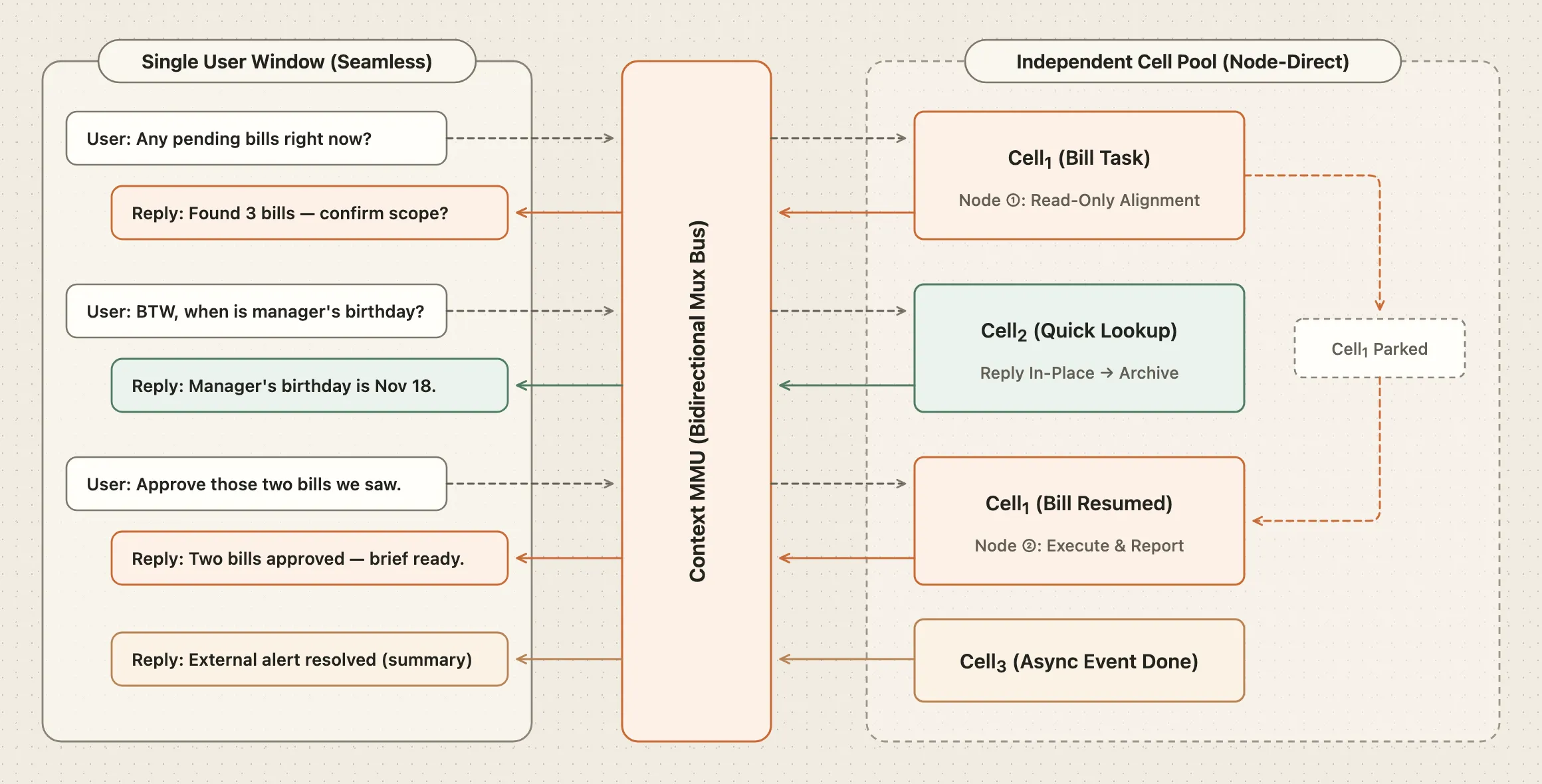
Within a single stream, Turn 1 might come straight from Cell 1 scoping a bug fix, Turn 2 from lightweight Cell 2 answering a read-only lookup in seconds, and Turn 3 from Cell n reporting a finished background run—with zero ticket rewriting in between. (Full sub-module schematics, formal operator definitions, and state-transition diagrams are detailed in arXiv:2611.26346.)
2.2 Four Primitives Along the Signal Path
-
Pluggable Virtual Context Scheduler (
Context MMU) — Single-pass System-1 routing without a generative router. Instead of running a stateful LLM session to write routing prose on every turn,Context MMUuses a pluggable, single-pass non-generative discriminator—instantiated either with a lightweight probability-scoring classifier (Jev) or via same-weight single-tokenlogprobsprobing of the backbone model itself (Logprob-MMU), eliminating any external model lock-in. Each routing call reads a compact global awareness prefix (workspace layout,AGENTS.mdsummary, and live file/AST/CLI footprints of active and completed cells) to make four fast decisions:- Workspace-grounded noise filtering & dedup: drops group-chat chatter, green pings, and cross-channel duplicate webhooks while spinning up background cells only for genuine work.
- Three-way intent granularity: separates single atomic turns, sequential causal chains (kept in one cell to prevent state races), and truly orthogonal multi-intents (the only case that invokes a lightweight self-contained pronoun rewrite before parallel dispatch).
- Lifecycle continuation & caveat isolation: wakes completed cells in place on follow-ups, isolates local read-only caveats (e.g., “don’t touch code” on a lookup) from active background jobs, and asks a one-line clarifier only on genuinely ambiguous pronouns.
- Direct peeks & zero-directory
Observer Cells: routes status questions straight to the live cell, and spawns read-onlyObserver Cells—with zerogit worktreeallocation—for derived briefs or cross-checks that subscribe to an in-flight job.
-
Context Pool (
Context Cell) — Same-brain continuation from alignment to execution. Every task lives out its entire lifecycle inside the exact sameContext Cell, mounting any single-session harness kernel (such as unmodifieddsh) with its full native toolchain intact. Memory is split into a left-locked pinned prefix (Shared Trunk + Intent Spine) and an evolving right-hand tool trajectory:- Zero-directory read-only alignment: ambiguous scoping and standalone lookups run with read-only tools and no
git worktree, finishing and archiving in place. - Zero-compute parking & in-place promotion: when you pivot from Topic A to Topic B,
Cell Aparks untouched at zero compute. The moment you green-light A, that exact cell lazily mounts an isolatedgit worktree, unlocks write tools, and executes straight off its original alignment spine—preserving 100% of nuance and prefix KV cache with zero ticket serialization. - Prefix-preserving compaction: oversized tool outputs undergo middle truncation, and watermark compaction condenses early exploration into progress notes while keeping
[Shared Trunk + Intent Spine]byte-locked at the left edge.
- Zero-directory read-only alignment: ambiguous scoping and standalone lookups run with read-only tools and no
-
Synaptic Bus (
Synapse) — Lateral fact sync and a portable three-stage trial merge gate. Worktree isolation shields concurrent cells from each other’s raw tool logs, but blind walls turn overlapping edits into last-mile merge cliffs.Synapsebridges peers horizontally without routing through a top-level manager:- Live AST footprint sensing: static AST parsing and CLI domain tags track what every cell touches. Overlapping edits trigger non-blocking alerts so peers can selectively
Peekat each other’s diffs during coding; when one cell lands onmain, overlapping siblings receive an immediate trunk-advance notice. - Portable three-stage isolated trial merge gate: no cell merges blindly onto
main. At settlement, each cell runs a trial merge inside its own isolated worktree along three paths: (i) zero-LLM fast-track when Git merges cleanly and AST/MMU confirm orthogonality; (ii) isolated model-driven reconciliation with sibling intent/diff context when Git conflict markers appear, verifying unit tests before promoting tomain(and rolling back cleanly on failure); and (iii) semantic joint testing whenever line-clean merges still touch shared symbols. Crucially, this settlement gate is self-contained and portable—it can even be bolted directly onto a standardRouter + Workerstack. - Cross-modal milestone sync & hot-injection: verified milestones (e.g., an office rule change affecting a live calculation) and mid-flight user refinements append cleanly to the target cell’s next tool return under a one-way refractory ledger to prevent echo loops; explicit cancellations abort and roll back cleanly.
- Live AST footprint sensing: static AST parsing and CLI domain tags track what every cell touches. Overlapping edits trigger non-blocking alerts so peers can selectively
-
Shared Base Context (
Shared Trunk) — Cache-safe three-tier experience retention. Rather than an active agent,Shared Trunkis a byte-identical static prefix locked at the left edge of every cell across three tiers: L1 Pinned Core (immutable rules,AGENTS.md, and uniform full tool schemas—read-only enforcement happens in the executor so prompt bytes stay identical across cells), L2 Active Experience (verified environment/API contracts anchored to commit or file hashes, distilled only when a cell closes a real error-to-fix loop), and L3 Cold Archive (low-reuse entries demoted behind one-line pointers for on-demand tail-appended recall). Newly distilled contracts wait in a staging queue and flush only at idle wave boundaries so active KV caches are never invalidated mid-run.
Put together, the runtime loop is simple: in an A → B → A interleaved chat, Cell A scopes Task A with zero worktree, parks intact while Cell B answers read-only lookup B (isolating any local “don’t touch data” caveat), and promotes straight to background execution the instant you approve A. When an async webhook launches a background run and you ask in chat for a cross-check brief, Context MMU links a zero-worktree Observer Cell via Synapse instead of spawning a blind duplicate worker.
3. What We Found: Removing the Router in Practice
To test whether virtualizing context blocks beats human-style delegation without confounding single-task harness quality, we locked the exact same unmodified dsh execution kernel and DeepSeek V4.1-Flash-1017 across every orchestration paradigm (Single-Session / DSH-Mono, Subagent-Fork, Subagent-Neutral, Agent Team, DSH + SuperAgent, and ClonAct) and evaluated them on three zero-overlap, deterministically graded programmatic suites: Synaptic-Bench-150 (150 multi-threaded Office, Coding, and Hybrid episodes mounting live Git repos, PostgreSQL, and app sandboxes with deterministic tool-step Step-Hooks), AppWorld-Micro-30 (30 app-disjoint everyday errand controls), and Synaptic-Stream-60 (continuous 240-event omnichannel streams across 3 persistent monorepo + 17-persona workspaces under Moderate and 2.5× Surge arrival rates). Full benchmark protocols, 1,800-episode breakdown tables, and statistical tests are reported in arXiv:2611.26346 and GitHub. Here are the three most revealing—and counter-intuitive—engineering findings.
3.1 Queueing Phase Transition & the “Inverse Load–Token Paradox” under Continuous Arrivals
Inspired by the DeepSeek Super-agent team’s cumulative arrival-curve experiment, Synaptic-Stream-60 removes Git merge conflicts completely (0% intra-stream file overlap by construction) to isolate pure arrival queueing and control-plane scaling. Comparing sparse Moderate traffic (~30s/request) against 2.5× Surge (~12s/request) exposes two sharp systems phenomena:
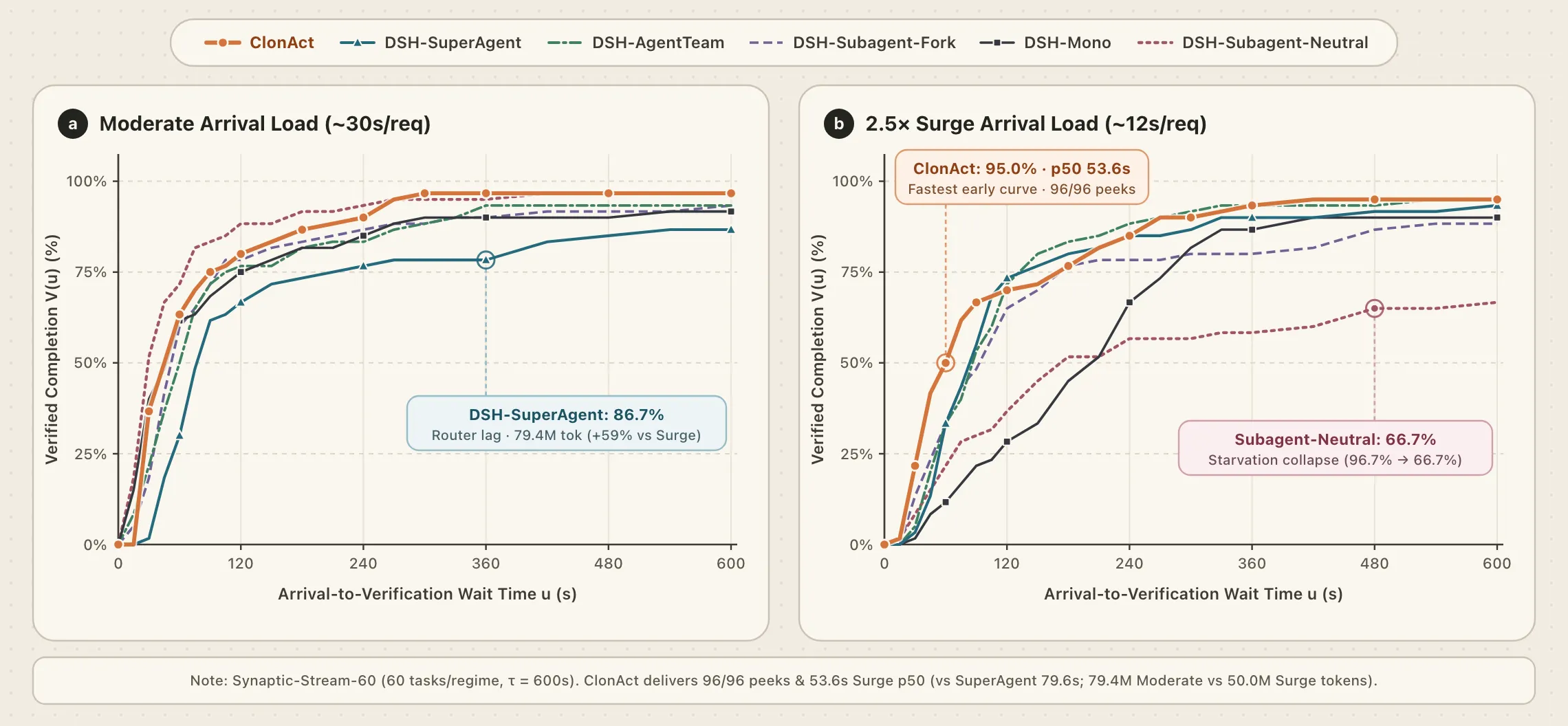
- Queueing phase transition and voluntary-delegation starvation: Under sparse Moderate traffic, queueing is mild and
Subagent-Neutral(a single session allowed to delegate voluntarily) looks fastest—tyingClonActat96.7%completion with a lower restricted mean wait (RMW_60072.0svs.89.3s) by running short errands inline, though it silently stalls37/48mid-flight status checks. Under2.5×Surge, single-server saturation hits a cliff:DSH-Mono’s median wait blows up4.1×(45.7s → 187.6s), andSubagent-Neutralcollapses from96.7%to66.7%(RMW_600 = 297.8s). Trace forensics catch the culprit—voluntary-delegation starvation: on Stream 3,Subagent-Neutral’s main session enters a737.5ssingle-turn coding loop that finishes all 3 code tasks while starving all 17 concurrent AppWorld errands (3/20verified).ClonActavoids saturation cleanly, tyingAgent Teamat top Surge completion (95.0%,57/60), leading aggregate Surge speed (RMW_600 = 119.4s) with the lowest median wait (53.6svs.79.6s–87.9sfor other multi-worker paradigms;41.8sread-only QA and51.9sAppWrite median waits), passing12/12(100%) mid-flight spec amendments across both regimes, and answering96/96untagged status checks with zero timeouts (7.3sModerate,9.2sSurge). By comparison,SuperAgentreplies quickly when idle (4.8s/5.9s) yet times out on7/96checks when its resident router is busy, while non-router loops stall68.8%–95.8%of Surge peeks (Agent Teamstalls33/48). - The “Inverse Load–Token Paradox”: Even with zero file conflicts and identical event counts,
SuperAgentburns 59% more tokens under sparse Moderate traffic than under 2.5× Surge (79.4Mvs.50.0Mtokens/stream). Session traces explain why: spaced Moderate arrivals trigger94.3stateful router turns per stream—replaying a growing orchestrator history atΘ(T²)cost (36.9Mrouter tokens,46.4%of total spend)—whereas dense Surge bursts accidentally coalesce into11.7batched inbox turns (13.8M,27.7%).ClonAct’s statelessContext MMUstays load-invariant across both regimes (301–303calls,2.80M–2.95MSystem-1 tokens) while preserving96.9%–97.5%System-2 worker prefix caching, cutting total prompt tokens by45.1%(Surge) to71.7%(Moderate). - Honest engineering trade-offs: Two real-world costs show up clearly in the numbers and deserve stating plainly. First, under dual-tier USD API pricing,
ClonActcuts total spend by24.6%on Moderate streams ($0.494vs.$0.655/stream), whereas under Surge the spend hits near-parity ($0.545vs.$0.528/stream, and aboveAgent Team’s$0.319) despite45.1%fewer tokens—because301uncachedJevcalls across 240 events cost$0.118/stream whileSuperAgent’s coalesced router replay absorbs98.2%prefix-cache hits. Second, on conflict-free coding tasks, worktree isolation trades roughly95sof branch-promotion latency (248.8sonClonActvs.146.2sin-place onDSH-Mono/151.9sonSubagent-Fork) in exchange for zero unrecovered regressions and strong merge safety (while still avoiding worktrees on every read-only lookup:14.0vs.SuperAgent’s20.0per stream).
3.2 Separating Merge Safety from Routerless Efficiency (Plus Two Real Traces)
Across all 150 episodes (413 deterministic checks) of Synaptic-Bench-150, ClonAct delivers the highest pass rate at 74.7% (112/150)—ahead of DSH + SuperAgent (72.0%), Subagent-Fork (68.7%), DSH-Mono (66.0%), and Agent Team (60.0%)—while cutting input prompt tokens by 45.9% (510.6M vs. 943.7M), halving git worktree allocations (148 vs. 295, -49.8%), lowering dual-tier USD spend by 38.9% ($6.92 vs. $11.33), and standing as the sole paradigm to pass 100.0% (161/161) of Tier-1 orchestration and safety checks. Separation concentrates sharply at coupled boundaries: cross-modal H-3 rises to 91.7% (vs. 66.7% on SuperAgent and 33.3% on DSH-Mono), while on app-disjoint everyday errands (AppWorld-Micro-30), ClonAct reaches 90.0% (95.0% subtask TGC), matching single-session DSH-Mono (93.3%) with zero coordination drag—whereas SuperAgent drops to 76.7% (85.0% TGC) at 2.3× the token volume (1,576k vs. 696k tokens/ep) and 2.2× slower wall-clock (146.3s vs. 65.6s).
Single-variable ablations on the stratified Bench-60 subset confirm that each primitive hits its intended slice: dropping same-brain continuation causes the steepest overall drop (80.0% → 63.3%, with C-1 + O-1 interactive alignment falling from 81.8% to 27.3%), while stripping Synapse leaves Office untouched (83.3%) yet collapses C-2 concurrent merges from 83.3% to 16.7%.
More importantly, a crossover control and 3-run stability check on Track C-2 cleanly disentangles where the merge gains come from versus what dropping the router actually buys:
- Portable gate sets the merge ceiling; dropping the Router cuts the bill in half: When we bolt
ClonAct’s portable Three-Stage Trial Merge Gate onto unmodifiedSuperAgent(SuperAgent + Trial Merge), its Run-1 true-conflict merge rate jumps immediately from10.0%(1/10) to80.0%(8/10), matchingClonActwith exact20/20episode concordance (70.0%all /60.0%disjoint). Across 3 independent runs on the 10 true-conflict pairs (30paired trials/arm, against a90.0%undisturbed single-task oracle ceiling),ClonActwins3/3runs (80% / 50% / 60%, mean63.3%) over vanillaSuperAgent(10% / 40% / 50%, mean33.3%, a1.9×lift). Yet achieving that80%ceiling on top of a generative router and blind worktrees forces post-hoc reconciliation on19/20episodes—costing12.97Mtokens/ep,$2.73,549.0s/ep wall-clock, and96.7%safety (one episode’s tasks silently dropped by the router).ClonAct’s routerless architecture hits the exact same70.0% / 80.0%ceiling with51.2%fewer tokens (6.33M/ep),45.5%lower USD spend ($1.49),32.5%faster wall-clock (370.7s),32.1%faster peeks (9.4svs.13.8s), and100.0%safety.
Two real forensic traces make those aggregate numbers concrete at the tool-call level:
-
Trace 1: Coding-time signature alignment on concurrent edits to the same function (
PA150_C2_12,pallets/jinja) Two concurrent requests targetedsrc/jinja2/filters.pyinjinja: one adding acase_sensitiveparameter to the sync and asyncgroupby()filters, and another adding areversesorting parameter to the exact samegroupby()filters.- In
DSH + SuperAgent, both workers wrote clean code and passed tests in their own isolatedworktrees; upon merging back tomain, however, the second merge overwrote the first worker’s signature changes, crashing jointpytestimmediately withTypeError: sync_do_groupby() got an unexpected keyword argument 'case_sensitive'(4 prior tests failed). - In
ClonAct, as soon asCell_E_1andCell_E_2both touchedfilters.py,Synapsefired an AST symbol overlap alert;Cell_E_2executed 4 targetedPeekreads to seecase_sensitivetaking shape. OnceCell_E_1merged intomain,Cell_E_2received the trunk-advance notice, pulledmaininside its ownworktree, unified the signature to(..., default=None, case_sensitive=False, reverse=False), resolvedCHANGES.rstcleanly, and landed onmainwith all 300+ associated tests passing on the first try.
- In
-
Trace 2: Zero-bleed isolation between a foreground read-only caveat and background coding (
PA150_H3_10,dottxt-ai/outlines) An external GitHub issue triggered backend implementation of a Windows-styleGUIDregex type (types.guid) with unit tests inoutlines; moments later, the user sent a foreground chat message asking to track progress read-only and draft a Release & Office Cross-Check Brief, explicitly noting “read-only tracking—do not modify business code.”- In
DSH + SuperAgent, because the external webhook and foreground chat landed in the same linearRoutersession, that local “do not modify business code” instruction polluted and swallowed the primary coding job—SuperAgentdispatched only a read-only brief ticket, wrote zero lines ofguidcode (changed_filesempty;pytestfailed during collection withAttributeError: module 'outlines.types' has no attribute 'guid'), and returned a hollow brief over an untouched repo (the exact same cross-topic pollution recurred inPA150_H3_07andPA150_H3_11). - In
ClonAct,Context MMUcleanly routed the GitHub coding job toCell_E_1(mounting an isolatedworktree, implementingoutlines/types/__init__.pyand tests, passing all84pytestcases, and merging tomain) while isolating the foreground brief request into a zero-worktreeCell_Obs_2subscribed viaSynapse—preventing local read-only caveats from contaminating background coding and emitting an accurate brief once verified changes landed.
- In
3.3 Zero External-Model Lock-In, and Preventing Compact-Model Router Collapse
Two final system questions matter if you plan to ship this pattern in production: Does single-pass gating lock you into an external classifier like Jev? And what happens when you swap out a flagship backbone for a faster, more compact model?
- Same-weight
Logprob-MMUeliminates external classifier lock-in: Replacing all671Jevcalls acrossBench-60(487) andMicro-30(184) with single-tokenlogprobsprobing on the exact same frozen backbone (DeepSeek-V4.1-Flash-1017,0external classifier calls) reaches81.7%raw (49/60) /83.7%IPW onBench-60—matchingJev(80.0%/81.6%) while beating generative JSON routing (66.7%/73.4%) by+9net episodes, with5.3smid-flight peeks,98.5%Tier-1 safety, and98.1%System-2 prefix cache hits. Single-pass probability gating is therefore an architectural property, not a vendor dependency—though on short-horizonMicro-30there is still room to sharpen fine-grainedM-2read-to-write transitions (80.0%vs.90.0%overall,60.0%vs.90.0%onM-2, while holding100.0%read-only safety and hygiene). - Preventing compact-model router collapse across backbones: Evaluating across three model families—
DeepSeek-V4.1-Flash-1017,Qwen3.8-Flash, and compactGPT-6-Luna(270paired episodes and828verifier checks per arm across Combined-90 =Bench-60+Micro-30)—ClonActleads pooled Combined-90 episode resolution (63.0%vs.SuperAgent51.5%,+11.5 pp, with43.6%fewerBench-60tokens, and ahead ofDSH-Mono’s59.6%) and ranks #1 in total verifier pass rate across all three models (84.7%pooled vs.79.8%Monoand74.0%SuperAgent) with100.0%Micro-30hygiene and4.5×–5.9×faster peeks thanMono. Most strikingly, when stepping down to compactGPT-6-Luna, prose ticket rewriting collapsesSuperAgentto27.8%(0.0%on bothC-2andM-1;63.3%hygiene) as the small router drops parameters and mis-filters personal app requests. By offloading ingress gating and keeping the user’s original intent spine verbatim,ClonActholds48.9%(+21.1 pp,100.0%hygiene,100.0%H-3)—reinforcing a clean boundary: good context scheduling removes coordination tax and handoff collapse, while single-task reasoning floors (such asQwen3.8-Flashending multi-file refactors early orGPT-6-Lunarefusing post-alignment writes onO-1) remain governed by the base model itself.
Full Paper & Reproducibility: For all 1,800-episode tables, per-track splits, statistical confidence intervals, ablations, and reproducibility scripts, see arXiv:2611.26346 and our open-source repository on GitHub.
4. Limitations
Building and stress-testing this architecture also surfaced two practical limitations worth stating plainly:
4.1 Shifting from Router Optimization to Jev Classification & Coreference: Cold-Start Ambiguity on Similar Tasks
Removing the Router does not make routing disappear—it shifts the challenge from “optimizing Router ticket comprehension and paraphrasing” to “handling Jev classification accuracy and single-window coreference resolution.”
Mounting live runtime file and symbol footprints gives Jev strong separability once two tasks start executing and touch distinct files or APIs. However, during the very first 1–2 turns when two highly similar tasks have just been initiated and have not yet produced differentiated tool footprints (for instance, investigating two similar bugs in the same module almost simultaneously), the margin for error remains narrow—especially when users rely on terse, pronoun-heavy chat messages like “tweak that spot we just talked about too.” A misattribution at cold start that routes a Task B instruction into Cell A (or links the wrong Synapse) can still cause context cross-talk.
4.2 Blurry Boundaries Between “Method” and “Product Engineering”
Working on this problem highlighted a broader tension: in Personal Agent research, drawing a clean line between “core method” and “product engineering” is genuinely hard.
“Personal Agent” is inherently a product-shaped concept rather than a sterile, idealized algorithmic problem. To run rigorous, apples-to-apples end-to-end evaluations, Synaptic-Bench-150 necessarily enforces product-grade closure requirements—such as demanding that concurrent tasks merge cleanly back onto a single main branch and enforcing strict zero-side-effect guarantees on read-only turns.
Those requirements, in turn, forced our implementation to accrete substantial engineering machinery—most notably the heavy pipeline around lazy git worktree mounting, trial merges, and conflict reconciliation. While these mechanisms ensure airtight end-to-end verification, they inevitably make parts of the codebase less pure: a conceptually clean “schedule context blocks like virtual memory” core ends up wrapped in pragmatic engineering glue built to satisfy product closure and benchmark parity.
5. Reflections and Discussion
5.1 What Inspired This Direction?
The earliest seed of this approach came from a firsthand frustration while using Agent Team at high intensity.
When Agent Team first launched in February 2026, I used it heavily every day. My typical setup paired frontend, backend, and reviewer teammates; before writing code, I would have a deep architectural design discussion with the Team Lead, then open split tmux panes to watch every teammate’s live process—and even hop straight into an individual pane to chat with a teammate when needed.
Whenever I checked the written task tickets the Team Lead handed down after our alignment discussion (very much like the tickets in DeepSeek Harness’s Super-agent), I kept noticing the same thing: nuances I had emphasized repeatedly and cared deeply about during alignment had vanished during handoff. Even as models grow stronger and miss fewer surface instructions, collaborating via summarized paraphrasing is inherently lossy. Back then, I routinely had to jump into tmux, find the specific teammate, and manually patch the missing context back in myself.
After doing that enough times, one question became impossible to ignore: Why must every team member start from a blank slate waiting for a Team Lead to summarize context? Why can’t it directly inherit the full alignment context we just built and keep going?
Not long after I started building around this idea, Claude released session fork—which immediately clicked as the exact primitive I wanted, and shaped how I thought about multi-task coordination from then on.
Alongside that main thread, two cross-disciplinary ideas supplied key pieces of the puzzle:
SuperAgent’s single-entry form factor & Thariq’s AI-native Focus Dock: Open-sourcedsh-superagentdemonstrated the appeal of extending a single chat box into an always-on personal assistant (while exposing ticket-handoff taxes); around the same time, former Claude Code engineer Thariq shared an intriguing experiment driving the macOS Dock with the lightweight discriminatorJev—dynamically reshaping the workspace across focus modes and gating which cross-mode notifications deserve to interrupt the user. That directly inspired extracting context switching and notification gating into an ultra-thinSystem-1control plane (Context MMU).- OS virtual memory paging & homologous biological systems: Viewing session
fork, fast-thinking routing, and lateral state sensing together reveals a close parallel to OS virtual memory page tables (swapping context blocks in and out on demand) as well as distributed homologous structures in nature (autonomous peripheral rings in octopus arms, low-resistance sieve tubes in plants, direct gap-junction signaling between somatic cells)—where the most natural way for genetically identical clones to coordinate is shared-prefix branching plus lossless peer inspection.
Seen from this angle, our exploration is not a refutation of Super-agent, but a complementary piece under the shared premise of hiding session management details from the user: for massive macro-tasks that genuinely require top-down decomposition and orchestration, master-worker splitting retains clear value; for the concurrent, interleaved single-session-solvable tasks that dominate everyday personal assistance, scheduling context directly as a resource offers a lighter, lower-loss path.
5.2 Where Are the Boundaries of What We’re Building?
Coming back to our method, the core move is replacing the Router and taking it out of the loop. Doing that responsibly requires asking what job the Router was actually performing in the first place.
As highlighted in the DeepSeek report, a Router bundles task decomposition, task routing, and intent decomposition (alongside maintaining global context continuity behind a single entry). Unpacking those responsibilities reveals that “context continuity & intent routing” and “top-level task decomposition” are two fundamentally separable jobs: the former does not vanish when we drop the Router—global context continuity and lifecycle management still live cleanly inside Jev (Context MMU), just freed from heavy generative re-paraphrasing so they run faster and at far lower cost. What really deserves scrutiny is the latter: for everyday workflows, is top-level “task decomposition” actually necessary?
Following that question makes the boundaries of our approach crystal clear:
-
A single-session perspective already suffices for the vast majority of tasks In everyday work, a single session can almost always finish a task end-to-end. Single-agent loops today are already remarkably strong (see Anthropic’s Building agents: When to fold subagents into your main agent loop), and most tasks do not need a fleet of sub-agents splitting roles inside every session. From an engineering standpoint, the real Personal Agent bottleneck today reduces to “solving combinations of tasks from a single-session perspective.”
-
Everyday tasks are short, flat, and fast—and premature top-level splitting creates unforeseeable conflict risks Unlike proving Fermat’s Last Theorem or tackling Millennium Prize problems, everyday Personal Agent requests are predominantly short and fast, making low latency and low cost far higher priorities than upfront task decomposition. Users normally rely on one session per bug or errand (and occasionally even mix small errands inside one session out of convenience, imperfect as that is).
More importantly, splitting a task at the top layer introduces conflict risk: at the moment a top-level planner slices tickets, it cannot foresee whether those isolated sub-tasks will collide on shared files or interfaces mid-implementation.
What if we do encounter an extraordinarily complex problem—on the scale of recent thousand-agent explorations by OpenAI and Anthropic? An individual
Cellcan still invoke innersub-agentson demand, returning cleanly to the single-session perspective. Crucially, the pattern is notsub-agentnested insidesub-agent, but managing each single session via the Clone paradigm while letting an individual session invokesub-agentsonly when genuinely needed—freeing human attention across concurrent sessions behind one window. -
Does tracking multiple tasks in one window still tax human attention? One fair question is: if multiple
Cellsreport back into a single window, doesn’t watching several bugs still consume human attention—how is that different from opening multiple sessions yourself?If a user genuinely had to micromanage every step of every bug, a
Routerarchitecture would require the exact same human scrutiny—adding aRouterlayer does not magically shrink review effort. Our premise is precisely that a single modern agent is already strong enough to deliver a bug fix autonomously, so users do not need to babysit intermediate tool steps; what the single window eliminates is the mechanical tax of juggling windows, maintaining sessions, and manually ferrying context across them.
Stepping back, while much of our analysis above focused on quantifying token usage, latency, and pass rates—and for enterprises, cost and efficiency naturally come first—looking at wall-clock time and task success rate alone still falls far short of capturing how a Personal Agent actually feels on the user side (whether subtle intent survives intact, whether notifications stay calm and unobtrusive, and whether human flow remains unbroken). We still need richer benchmarks and more insightful metrics to measure what truly matters here.